Ask a superintendent in Griffin what actually costs them money on a job, and rework is near the top of the list. Not weather, not permitting — rework. A footing poured six inches off. A pad graded to the wrong elevation. A utility line trenched where a foundation is going.
Almost all of it traces back to layout.
Construction staking is the step that translates a set of engineered plans into physical marks on the dirt. Done well, it disappears into the schedule. Done poorly — or skipped — it shows up later as demolition.
What Construction Staking Includes
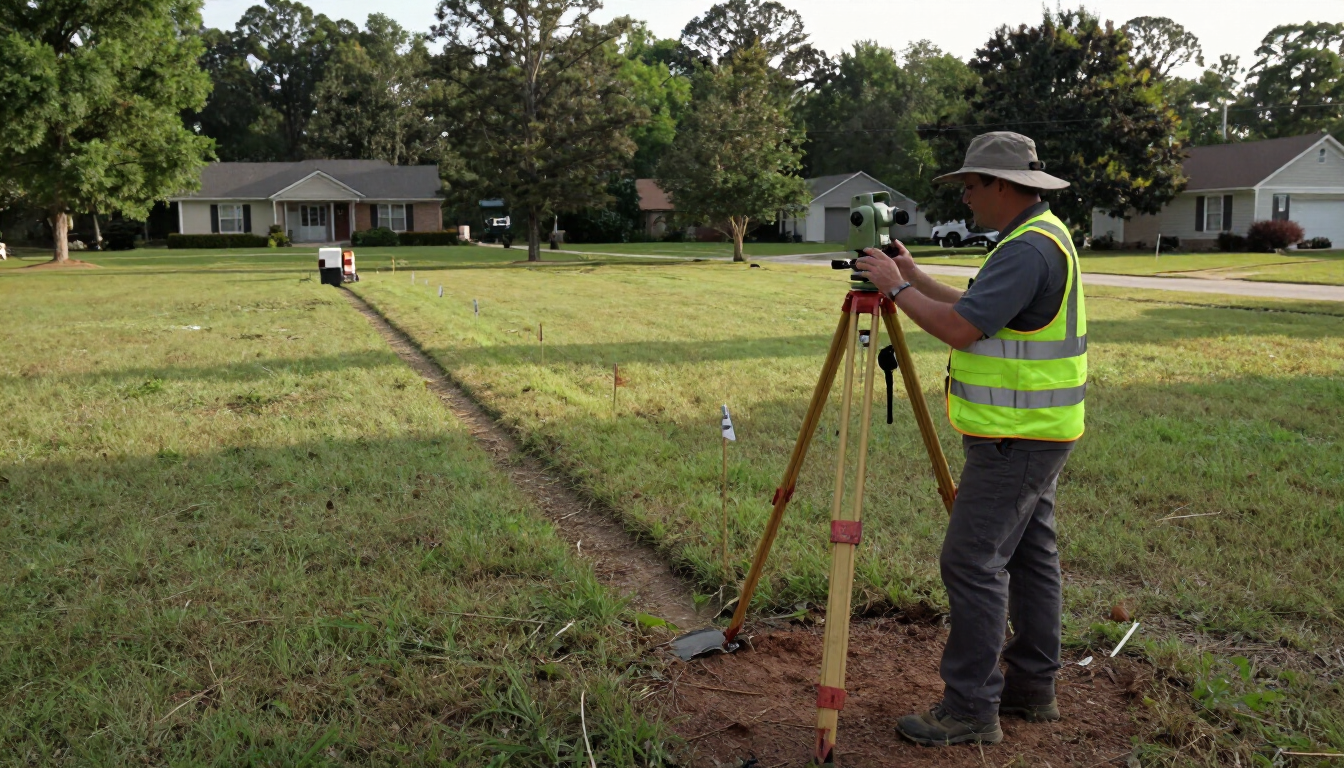
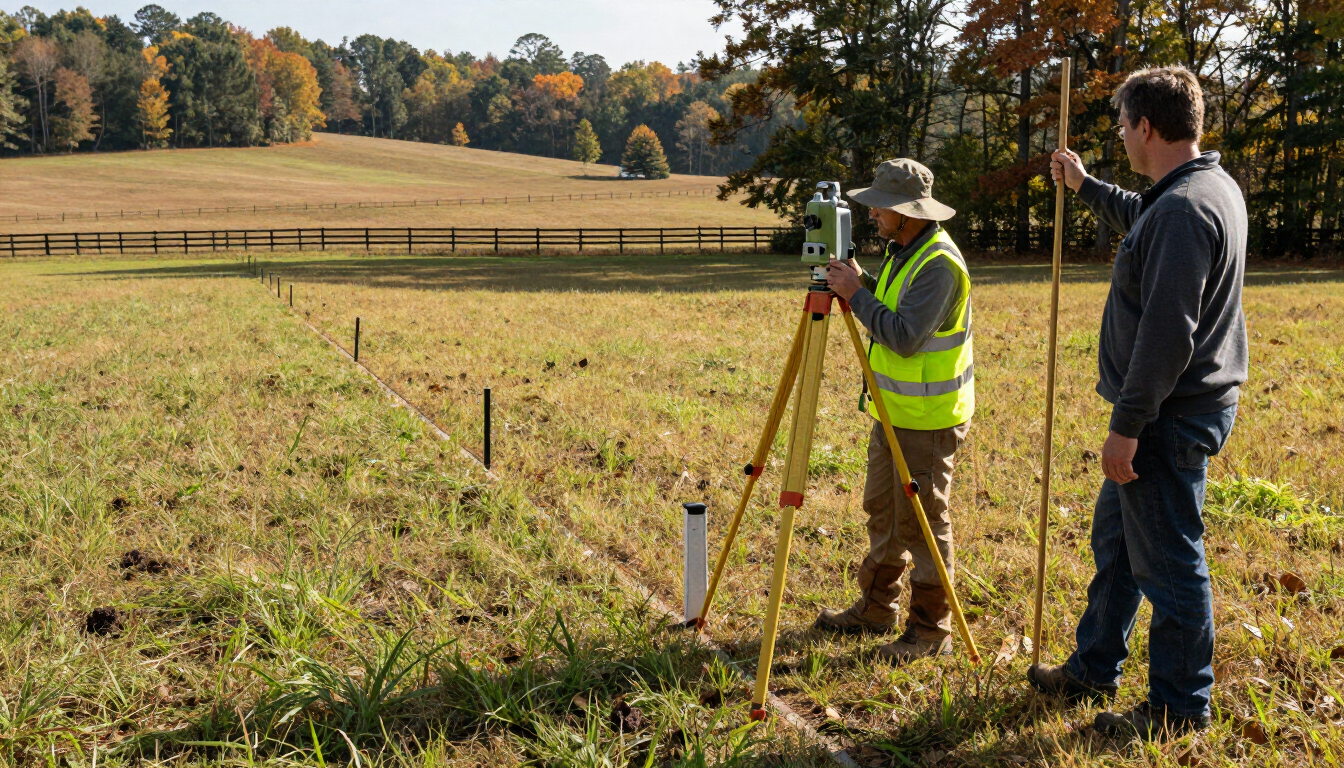
Construction staking is the surveyor's role during the build, not before it. We take the approved site plan, grading plan, and utility plan, and place stakes on the ground that crews build to.
Typical staking services on a Griffin project include:
- Rough grade and clearing limits — establishing where earthwork starts and stops
- Building corners and offsets — set off the actual structure so the marks survive excavation
- Foundation and footing layout — corners, wall lines, column locations
- Cut and fill grade stakes — telling the operator how far up or down to work
- Utility layout — water, sewer, storm, and service line alignments and inverts
- Curb, gutter, and pavement staking — alignment and elevation for hardscape
- Detention and drainage structures — placement and rim elevations
- As-built verification — confirming what got built matches what was designed
Not every project needs all of it. A single-family foundation on a platted Spalding County lot is a different scope than a commercial pad with a detention basin and three utility runs.
Why Griffin Projects Need Local Field Experience
Spalding County ground has its own personality, and it affects layout.
Red clay behavior. Georgia red clay holds a stake well in dry conditions and turns slick fast after rain. Stakes get lost, shifted, or buried by equipment. Crews that understand this set adequate offsets and reference points so layout can be recovered instead of re-surveyed from scratch.
Terrain and grade change. Much of the area around Griffin has meaningful topographic relief. Grade staking on rolling ground demands more control points than a flat site, and skimping shows up as a pad that doesn't drain. It's one reason a
topographic survey done before design pays for itself twice.
Older infrastructure. Griffin has been developed for a long time. Utility locations in older parts of the city don't always match the record, and existing conditions frequently differ from the plan set.
Mixed record quality. Spalding County was created in 1851 from parts of Fayette, Henry, and Pike Counties, and its records reflect that patchwork origin. Boundary questions that surface mid-project stop work. Catching them during layout, rather than after a wall is up, is worth a great deal — which is why we handle
surveying across Henry and Spalding County as one connected practice rather than isolated jobs.
Why Builders in Griffin Choose Legacy Surveying
Legacy Surveying carries more than forty years of combined local surveying heritage through Joe Rowan Land Surveying and Jeff Kuhn. Builders and general contractors keep calling us for four reasons:
We show up when we said we would. Staking sits directly on the critical path. A crew waiting on stakes is a crew being paid to stand still. Scheduling reliability matters as much as accuracy.
We set marks that survive the site. Offsets placed where equipment won't destroy them, clear labeling, and reference points that let us re-set quickly if something gets wiped out.
We flag problems instead of staking through them. If the plan doesn't fit the ground — a boundary conflict, an elevation that won't work, a utility conflict — you'll hear about it before concrete is ordered.
We're local. A same-day or next-day return trip is realistic when you're working out of Griffin, not out of metro Atlanta.
The Equipment Behind the Marks
Layout accuracy depends on control. We establish and maintain site control using high-precision GNSS satellite receivers and total stations, tying the project to the correct coordinate and elevation datum before the first stake goes in. All work is performed under the supervision of surveyors licensed by the
Georgia Professional Engineers and Land Surveyors Board.
That matters because staking errors compound. A control point that's off by a small amount at the start becomes a real dimensional problem by the time you're setting the last building corner.
How to Set Up a Staking Job for Success
Contractors who get the most out of staking do a few things consistently:
- Bring the surveyor in during preconstruction. Reviewing plans before mobilization catches conflicts cheaply.
- Send the current approved plan set. Staking to a superseded revision is a costly and entirely preventable mistake.
- Give real lead time on each phase. Rough grade, foundation, and utility staking are separate trips with separate scheduling needs.
- Protect the stakes. Brief operators on what's marked and what shouldn't be driven over.
- Contact
Georgia 811 before excavation. State law requires notice at least 48 hours but no more than 10 working days ahead of mechanized digging. Utility locating is a separate service from staking, and both are needed.
- Communicate plan revisions immediately. A change order that doesn't reach the surveyor becomes rework.
- Plan for as-builts up front. Many jurisdictions and owners require them, and it's easier when it's scheduled rather than remembered at closeout.
Frequently Asked Questions
What is construction staking?
Construction staking is the process of marking a design on the ground so crews can build to it. A surveyor places stakes showing horizontal locations and vertical elevations for buildings, utilities, roads, and grading based on the approved plans.
How much does construction staking cost in Griffin, GA?
Cost depends on project size, how many phases require staking, site conditions, and how many return trips are needed. Some projects are a single layout visit; others involve repeated mobilization over months. We price by scope after reviewing the plans.
Is construction staking the same as a boundary survey?
No. A
boundary survey establishes property lines. Construction staking positions a design within those lines. Many projects need both — the boundary work first, so the design is sited correctly.
What happens if stakes get destroyed during construction?
It's common, which is why we set offsets and reference points. Re-staking is usually quick when good control exists. Tell us as soon as marks are lost rather than estimating from what's left.
Do you provide as-built surveys after construction?
Yes. As-built surveys document what was actually constructed and are frequently required for permitting closeout, lender draws, or owner records.
How far in advance should I schedule staking?
As early as you can. Field scheduling tightens during good weather, and layout is rarely something you want to rush. Preconstruction is the right time to get on the calendar.
Do you work with residential builders as well as commercial?
Yes. We stake single-family foundations and custom homes as well as commercial pads, subdivision infrastructure, and site work throughout Spalding County.
Can you stake a project if someone else did the boundary survey?
Usually. We'll want to review the existing survey and verify control before building on someone else's work.
Keep the Schedule, Skip the Rework
Layout is a small line item on a construction budget and a large one on the change order log when it goes wrong. Precise staking, delivered on the day you need it, is the cheapest schedule protection available.
Need construction staking in Griffin, McDonough, Newnan, Barnesville, or anywhere in South Metro Atlanta and Middle Georgia? Contact Legacy Surveying today for site layout, foundation staking, utility layout, and as-built surveys backed by decades of local field experience.
Call Legacy Surveying at 404-569-9115 or
request your project quote online.